

Global trade is entering a phase in which trade flows are increasingly shaped not only by production costs, but also by security, predictability and access to infrastructure. According to Cushman & Wakefield’s report Waypoint: Global Industrial Dynamics 2026, supply chains now operate in an environment of structural uncertainty, with disruptions being an integral part of day-to-day operational planning. For Poland, this shift represents an opportunity to significantly strengthen its position in European logistics, provided that key infrastructure projects materialise as planned.
Multimodal hubs and the development of energy infrastructure as an opportunity for Poland
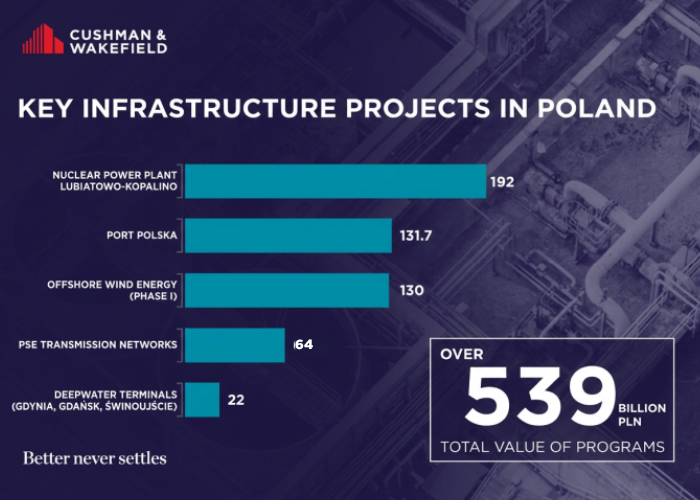
For years, tenants choosing logistics and industrial locations were driven primarily by rental costs. Today, however, rent is only the starting point in a broader decision-making process. Businesses must consider how the sudden closure of a shipping route – whether due to conflict, new tariffs or a surge in freight costs – would affect their operations in a particular location. That is why locations that enable them to handle deliveries from multiple directions, maintain adequate inventories of materials or products closer to their customers, and ensure business continuity even in the face of market turbulence are emerging as winners. Today, three factors determine whether a location is truly fit for purpose: reliable energy supplies, labour availability and the ability to launch operations efficiently. Infrastructure investment will strengthen Poland’s position only if it translates into sites where businesses can operate without interruption, rather than places that just look good on a map,”
says Szczepan Gowin, Head of Industrial & Logistics Agency, Cushman & Wakefield.
Investment capital is increasingly factoring geopolitics and infrastructure quality into risk assessments. The presence of large-scale warehouse space or a favourable location on the map is no longer enough. What matters is whether a given location has durable demand fundamentals: access to infrastructure, limited competing supply, stable tenants, income growth potential and high operational performance of assets. Mega infrastructure projects have the potential to strengthen these fundamentals in Poland, further reinforcing the country’s position in European supply chains and making it a more attractive destination for institutional capital,”
says Paweł Partyka, Head of Capital Markets Poland, Cushman & Wakefield.
About Cushman & Wakefield
Cushman & Wakefield (NYSE: CWK) is a leading global commercial real estate services firm for occupiers and investors with approximately 53,000 employees in over 350 offices and nearly 60 countries. In 2025, the firm reported revenue of $10.3 billion across its core service lines of Services, Leasing, Capital markets, and Valuation and other. Built around the belief that Better never settles, the firm receives numerous industry and business accolades for its award-winning culture. For additional information, visit www.cushmanwakefield.com.